
If the idea of working behind the scenes in a hotel appeals to you, but the exact nature of housekeeping roles feels unclear, this guide lays out the basics without embellishment. It covers the types of positions commonly available, the physical and technical demands of the job, the training and certification options that exist, current labor market conditions, where jobs are posted, and how progression typically works. A question-and-answer section at the end addresses recurring curiosities.
1. What Hotel Housekeeping Actually Involves Day to Day
Hotel housekeeping is not a single job title. It is a category that includes room attendants, housemen, public area cleaners, laundry staff, and supervisors . Each role has a distinct set of repetitive tasks.
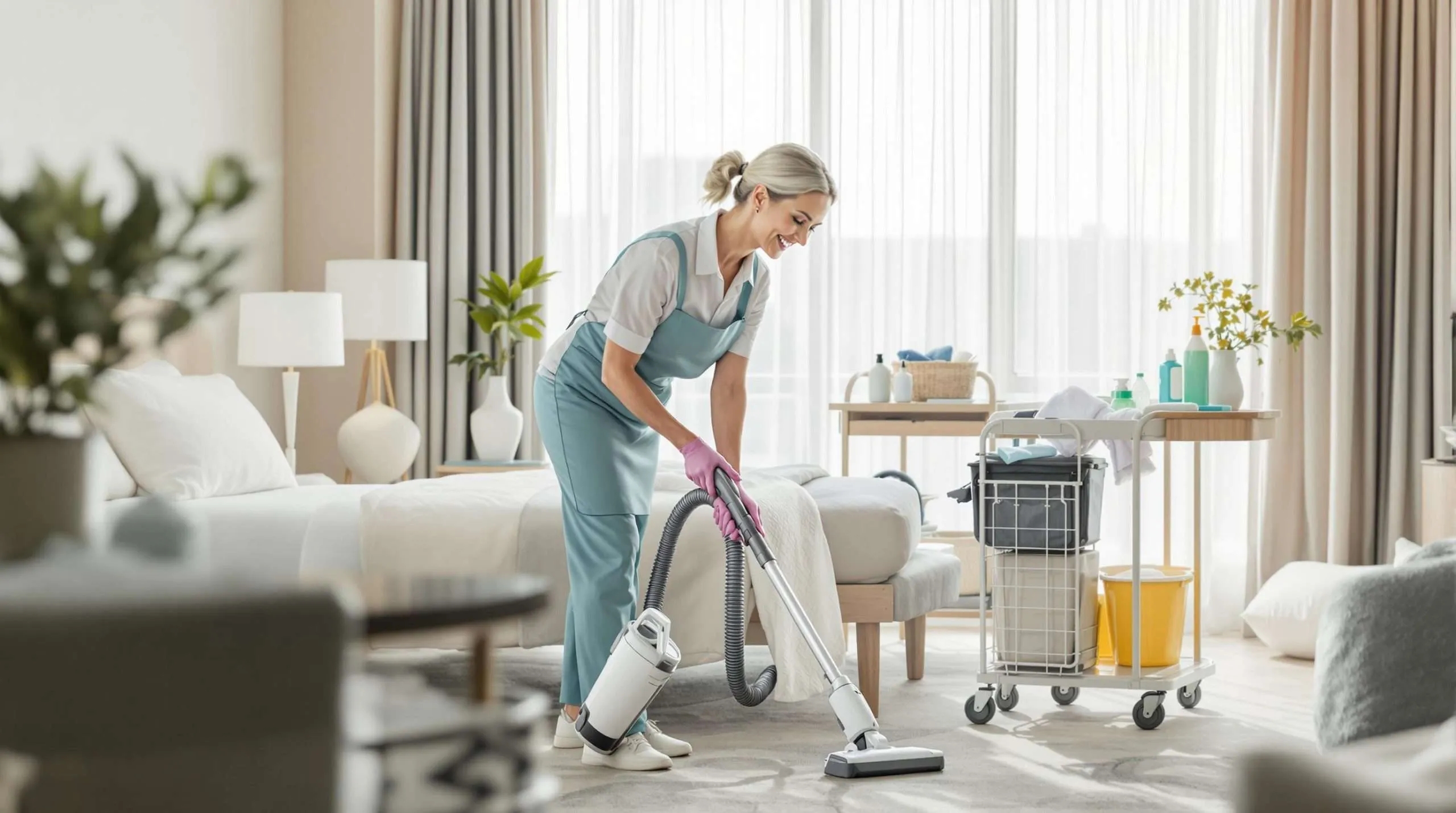
Room attendants clean guest rooms: make beds, vacuum, dust, scrub bathrooms, replenish toiletries and linens, and document room status via paper logs or mobile apps . Housemen handle heavy lifting—delivering rollaway beds, removing trash and soiled linen from hallways, stocking floor closets, and operating carpet shampoo machines . Public area attendants maintain lobbies, corridors, and restrooms. Laundry attendants process sheets and towels.
The work is structured around check‑in and check‑out cycles. During peak turnover hours, attendants are expected to complete rooms in under 30 minutes in some properties. Speed and consistency are measured.
2. Physical and Technical Demands
Housekeeping is physically repetitive. Marriott’s job description specifies lifting objects up to 55 pounds unassisted and over 55 pounds with assistance, pushing loaded carts over sloped surfaces, and continuous standing, bending, kneeling, and reaching overhead . Shifts often exceed eight hours, and weekend or holiday schedules are routine.
Technology is gradually entering the role. Some hotels use digital task assignment systems, handheld devices for room status updates, and RFID tracking for linen inventory . Basic familiarity with smartphones or tablets is increasingly expected.
3. Entry Requirements and Certifications
Formal education is not a barrier. Most positions require completion of compulsory secondary education or equivalent . Employers provide on‑the‑job training covering chemical safety, equipment handling, and brand standards .
Optional certifications exist. The International Executive Housekeepers Association offers the Certified Executive Housekeeper credential for candidates with a high school diploma or associate degree, and the Registered Executive Housekeeper credential for those holding a bachelor’s degree . TÜV also operates a Professional Cleaner scheme for tourist accommodations, which includes theoretical and practical examinations . These credentials are not required for entry but appear in some supervisory job postings.
4. Current Market Context
The global hospitality cleaning services market was valued at approximately USD 85.88 billion in 2025 and is projected to reach USD 152.7 billion by 2034, representing a compound annual growth rate of 6.6 percent . This expansion reflects sustained travel demand and heightened guest expectations around visible cleanliness.
Labor availability remains a persistent constraint. A 2025 survey of hotel operators indicated that 26 percent of respondents identified housekeeping roles as the most difficult to fill . In response, 61 percent of hospitality businesses improved benefits packages and 52 percent introduced flexible scheduling during 2023–2024 .
In the United States, annual salaries for room attendants typically range from USD 25,000 to USD 40,000, with a reported median of USD 32,500 . Entry‑level positions generally start near the lower end of this band .
5. Where Positions Are Listed
General job platforms such as Indeed carry thousands of seasonal and permanent hospitality listings . Specialty sites concentrate exclusively on hospitality. Hcareers, Hospitality Online, Hosco, and iHireHospitality are frequently cited by recruiters .
Seasonal positions with housing are listed on CoolWorks and SeasonalJobs.com, particularly for national park lodges and remote resorts . Major hotel chains also post directly on their corporate career pages .
6. Advancement Patterns
Progression is incremental and experience‑dependent. A room attendant with one to three years of experience may be considered for lead housekeeper or supervisor roles, which involve inspecting rooms, training new staff, and managing inventory . Further advancement to executive housekeeper or area manager typically requires additional education—either an associate or bachelor’s degree in hospitality management—and several years of supervisory experience .
Cross‑training in laundry, maintenance, or front office can broaden internal mobility, though this varies by property size and management philosophy.
7. Common Misconceptions
Housekeeping is sometimes viewed as isolated work. In practice, attendants interact regularly with guests, front desk staff, and maintenance teams . Communication skills are directly relevant to daily operations.
Another recurring assumption is that the work is unskilled. While no formal credential is required for entry, the role demands simultaneous management of time, physical effort, chemical safety, and brand standards. Digital literacy is becoming a baseline expectation in tech‑adopting properties.
8. What Employers Look For
Job postings consistently emphasize reliability, physical stamina, attention to detail, and the ability to follow procedures . Prior experience is not mandatory for entry‑level roles; many properties accept candidates without direct industry background and train them internally .
A clean criminal record and legal work authorization are standard prerequisites. Language proficiency beyond the local language is not universally required but is advantageous in international hotel brands.
Questions and Answers
Q: Is a high school diploma mandatory to become a room attendant?
A: Many employers prefer a high school diploma or equivalent, but some accept candidates without one if they demonstrate reliability and work ethic . Training is provided on the job.
Q: What is the difference between a room attendant and a houseman?
A: Room attendants focus on cleaning and preparing guest rooms. Housemen handle public area maintenance, heavy lifting, linen distribution, and floor upkeep tasks such as carpet shampooing .
Q: Are there seasonal housekeeping jobs that include accommodation?
A: Yes. Platforms such as CoolWorks and SeasonalJobs.com list positions in national parks, ski resorts, and remote lodges that provide on‑site or discounted housing .
Q: How long does it take to become a housekeeping supervisor?
A: Timelines vary. Internal promotion typically occurs after one to three years of consistent performance, though some properties require longer tenure or completion of hospitality coursework .
Q: Do housekeepers need to speak English to work in an international hotel?
A: In properties with a multinational guest base, conversational English is frequently expected. In domestic or regional properties, proficiency in the local language is usually sufficient.
Data Sources
- https://www.ziprecruiter.com/g/Most-Popular-Job-Types-Of-Hotel-Housekeeper-Jobs
- https://careers.marriott.com/housekeeping-associate/job/A905509338FFC7022C64397A94C491D6
- https://www.abs.gov.au/book/export/43477/print
- https://www.elevatepay.co/blog/best-websites-for-seasonal-hospitality-jobs
- https://jobicy.com/careers/room-attendant
- https://careers.rosewoodhotelgroup.com/vi_VN/carlyleco/FolderDetail/Doha-Ad-Daw-ah-RWDHA-Houseman/427078
- https://www.tuv-nord.com/gr/en/pistopoiisi/certification-of-persons/tourism-sector/professional-cleaner/
- https://www.manatal.com/blog/hospitality-job-sites-us
- https://www.researchandmarkets.com/reports/6184055/hospitality-cleaning-services-market-outlook